
USC Price Students Consult for Municipalities in Sunstone Economic Development Challenge
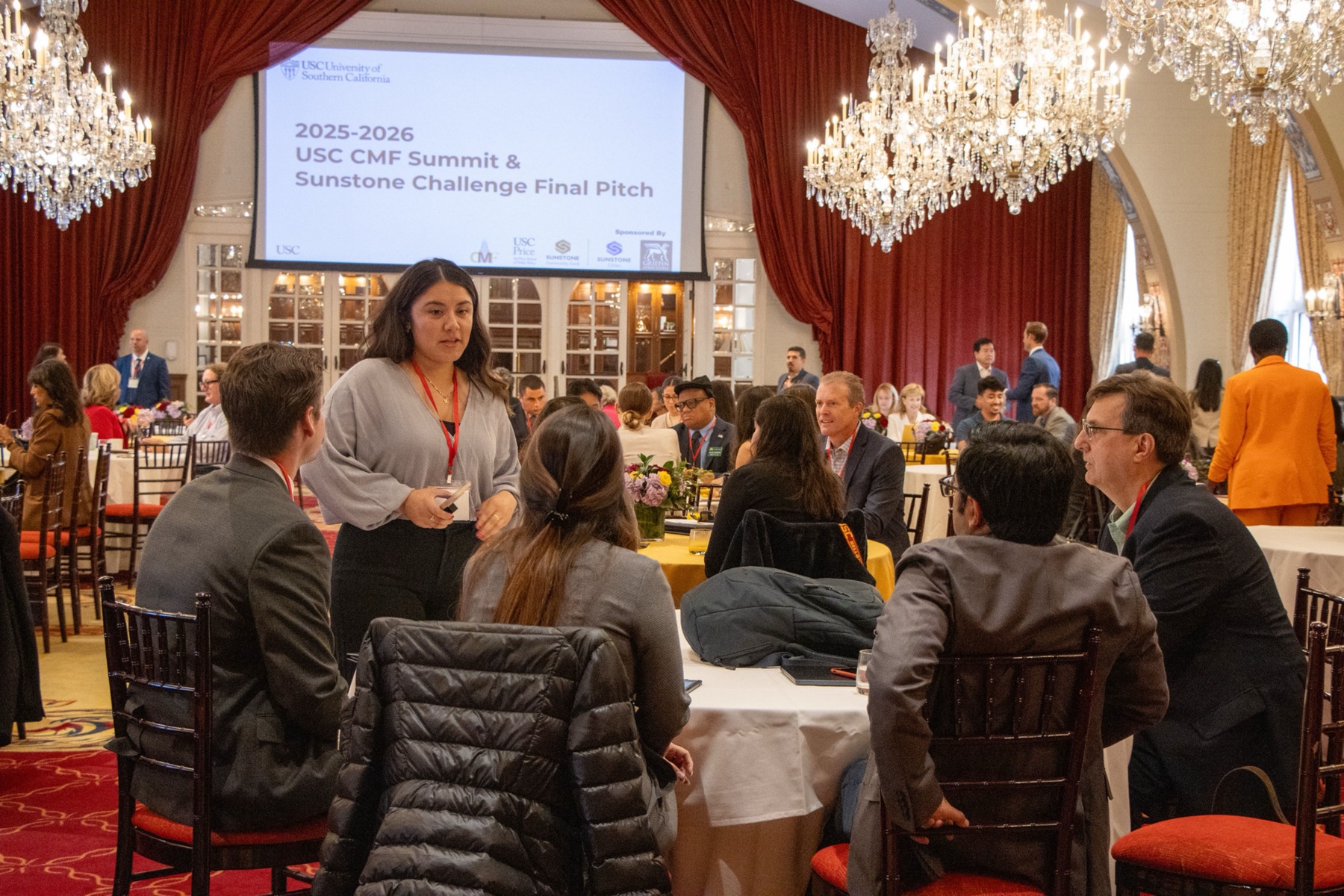
An expansive plan to create a workforce pipeline for new high-tech businesses in Riverside took the top prize April 23 at the Final Pitch event for the Sunstone Economic Development Challenge @ USC Price.
Feature
An expansive plan to create a workforce pipeline for new high-tech businesses in Riverside took the top prize April 23 at the Final Pitch event for the Sunstone Economic Development Challenge @ USC Price.
For the last six months, six teams of USC public policy graduate students have worked with local governments to develop strategies to promote economic growth in their municipalities. The program is supported and organized by the USC City/County Management Fellowship (CCMF) and Sunstone Cities. Prize money and sponsorship come from the Sunstone Community Fund.
The Challenge began in 2023 with five teams of students paired with municipalities. This is the first year six teams competed, primarily because of increased interest from both students and government officials, according to Peter Castro, chair of the USC City/County Management Fellowship and Deputy City Manager at Rancho Cucamonga.
“It just keeps getting bigger and better every year,” Castro said after the six teams presented their proposals. “The word’s out, and we had more cities apply than ever before. And the presentations keep getting better and more professional every year, too!”
John Keisler, a USC public policy alum as well as the CEO of Sunstone and the treasurer of CCMF, helped launch the Challenge. He encouraged the students before the presentations began.
“You’ve worked hard, and you’ve been able to see the inner workings of government,” Keisler said. "I know some of you are already working in public policy, even as you complete your course work… One of these days, you are the ones who will be leading the future of our communities, and we’re rooting for you.”
In fact, all four members of Team Riverside already are working/interning at city halls across the Southland. They are Hilda Aguilar-Jurado, Oscar Cisco, Vanessa Bautista, and Montserrat Pineda.
Team Riverside’s winning presentation leaned on strong research – 70% of current Riverside employers struggle to fill roles while 80% of residents commute outside Riverside for employment – to create its RENEW (Riverside’s Economic Navigation and Expansion of Workforce) Plan. By creating a workforce development program, the team said, more residents would stay in the city to work and spend money. A strong workforce and innovation in already strong medical and biotech fields would create an environment to foster more businesses, especially in the Aerospace Medicine field.
The three-judge panel, all top city or county officials, praised the team’s research and in-depth planning documents. The one suggestion the panel made was to be sure there is a small business component to provide balanced economic development.
Judges were Rebecca Kauma, Director of Digital Equity for Los Angeles County; Teresa Garcia, Senior Project Manager for the City of Pasadena; and Lucy Garcia, Assistant City Manager at the City of Alhambra.
Second place in the competition went to Team San Bernardino, who worked with the county and the town of Bloomington in particular. Known primarily as a trucking hub, Bloomington’s main corridor could be revived with investment in city infrastructure and creation of a Plaza del Valle Mercado. While judges questioned the source of a needed $90 million investment, they praised the team for their in-depth research that included interviews with multiple residents.
In third place was Team Lake Elsinore, the first team to present. Revitalizing commercial areas would help retain current businesses and attract new businesses, the team said, to take advantage of the potential for new housing. Outdoor recreation, long a Lake Elsinore strength, should also be emphasized.
The other teams worked with and represented the cities of Mission Viejo, Sutter Creek and West Covina. Those experiences made the students and cities winners as well, officials said.
“We thought it was worthwhile, really energizing,” said Cliff Jones, Mission Viejo’s Planning and Economic Development Manager. “It is refreshing to see the new ideas they come up with. It’s useful to get a youthful perspective.”
Team members of the top three teams will split cash prizes provided by the Sunstone Community Fund, a nonprofit donor-advised fund. First place won $5,000, $3,000 for second and third took home $1,500.
The graduate students who made up the teams were unanimous in their praise of the program and the experience. Working in the “real world” made their chosen path of public policy more attractive, several said.
“Winning felt amazing,” said Montserrat Pineda, a member of Team Riverside. “It was exciting to be consulting in a real-time situation, too. We are all already working in city halls, but this just confirms what I want to do.”
All of the teams have posted their memos to the governments they worked with and the PowerPoint presentations they used for their pitch here.
For more information about the Sunstone Economic Development Challenge @ USC Price and to sign up to get information about next year, go to sites.usc.edu/sunstone-price-challenge/.
About Sunstone Cities: Sunstone Cities is an economic development consulting firm that helps local government leaders unlock economic development, new business formation, job growth and infrastructure financing. Data-driven insights, industry expertise and public-private partnerships help cities revitalize economies, attract businesses and better monetize community assets.
More News
Continue reading
August 3, 2026
Cities sought for next Sunstone Economic Development Challenge @ USC Price
Cities can apply for free economic development assistance through the fifth annual Sunstone Economic Development Challenge @ USC Price. Article originally published on PublicCEO.
April 24, 2026
CSULB Student Entrepreneurs Win Support, Advice At Sunstone Innovation Challenge
Student entrepreneurs at California State University, Long Beach, got a boost Tuesday, April 21, at the 2026 Sunstone Innovation Challenge presented by the CSULB Institute for Innovation & Entrepreneurship.
December 1, 2025
Recovery from Wildfires Depends on Leveraging Public-Private Partnerships
The Eaton and Palisades wildfires show why coordinated public-private partnerships are essential to faster recovery, rebuilding, and community resilience.